
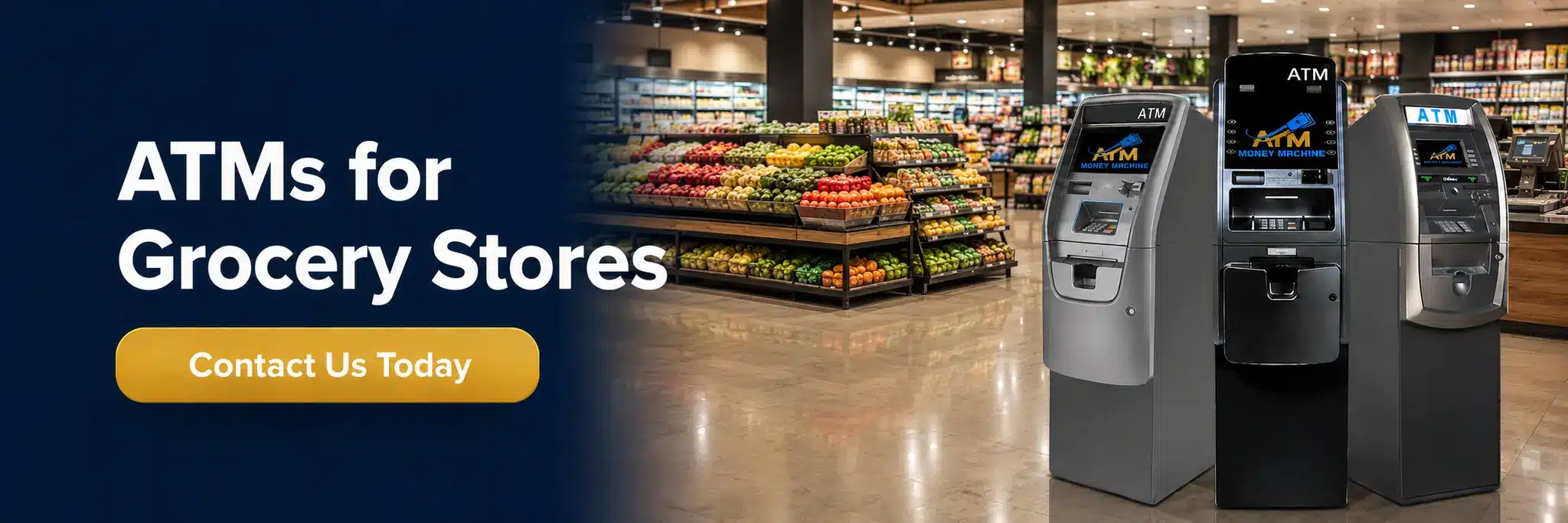
ATM Machines for Grocery Stores
A lot of grocery shoppers want to pay in cash. When there’s no ATM in the store, that demand doesn’t disappear, it turns into cash-back requests that tie up your registers, or it sends customers down the street to a competitor’s machine. An on-site ATM keeps that cash demand, and the spending that comes with it, inside your store. It can also bring new customers through the door, since people looking for a nearby ATM often buy something once they’re inside. On top of that, the machine adds a steady stream of surcharge income. ATM Money Machine has sold and supported thousands of machines over nearly 30 years. We’re a family-owned, direct ISO founded in 1997, with in-house processing and a BBB A+ rating.
Why Grocery Stores Need an ATM Machine
No matter the size of the store, cash is part of how grocery customers pay. Lottery tickets, the deli and bakery counters, produce and specialty vendors, and shoppers who simply prefer cash all keep physical currency moving through the aisles. When a store has no ATM, that cash demand doesn’t disappear. It gets pushed onto the cashier as a cash-back request, or it walks out the door to a competitor’s machine down the street. An on-site ATM captures that demand and turns it into a benefit for the store instead of a cost.
Eliminate Cash-Back Requests That Drain Your Registers and Slow Checkout
Cash-back at the register looks harmless, but it quietly costs you. Every cash-back request opens the drawer more often, which increases the chance of miscounts and shrink, and forces more frequent mid-shift drawer drops and refills. It also adds a card transaction the store pays a fee on, since cash-back is processed as part of the card sale. On top of all that, it slows the line at the exact moment when speed matters most. A dedicated ATM moves that cash demand off the register entirely. Customers get their cash from the machine, cashiers keep the line moving, and the drawer stays closed between actual sales.
Reduce Credit Card Processing Fees on Every Transaction
Card processing generally costs a grocery store between 2% and 4% per transaction, and across a month of sales that adds up. Every time a shopper pulls cash from your ATM and pays with it instead of a card, the store keeps that fee instead of handing it to the processor. Move even part of your sales to cash and you’re cutting a cost you pay on every single card transaction.
Customers with Cash in Hand Spend More
There’s a well-understood pattern in retail: people who withdraw cash tend to spend it close to where they took it out, and they tend to spend more of it than they planned. A shopper who pulls forty or sixty dollars from the ATM by your entrance is far more likely to spend that money in your aisles than to carry it out to a competitor. Without an on-site machine, a customer who needs cash has to leave, and once they’ve left, there’s no guarantee they come back. Keeping cash accessible inside the store keeps that spending inside the store.
Earn Surcharge Income on Every ATM Transaction
Every withdrawal on your machine carries a surcharge fee, and that fee is paid by the person using the ATM, not by the store. It’s one of the few additions to a grocery store that generates income without adding labor, inventory, or floor-plan complexity. To put real numbers on it: the national average ATM surcharge is $3.22 per withdrawal, according to Bankrate. A machine averaging 300 withdrawals a month generates roughly $966 in gross surcharge revenue over that period, and that income adds up month after month.
How a Grocery Store ATM Machine Impacts Your Bottom Line
An ATM affects a grocery store’s finances in two directions at once. It adds a new revenue line, and it removes costs the store was already absorbing. Together, those two effects are what make an owned machine one of the more sensible additions a grocery operator can make to the front of the store.
ATM Surcharge Revenue Adds a New Profit Stream Without New Inventory
Everything else in a grocery store is inventory that has to sell fast to make money. You buy it, you hope to move it before it spoils, and if it doesn’t, that’s money off your bottom line. An ATM isn’t inventory. It takes no shelf space, nothing about it spoils, and it earns a surcharge on every withdrawal without anything having to come off a shelf. It’s a second line of revenue running alongside your grocery sales instead of competing with them for space.
Fewer Card Transactions to Reconcile at Close
Closing out a register at the end of the day already means settling the credit card batch, matching the terminal’s totals against what the register rang up, and running down anything that doesn’t tie out. Cash-back makes that worse. Because it’s processed as part of a card sale, every cash-back request rides along in the batch you have to settle and reconcile, and it pulls cash out of the drawer you then have to count and balance against it. An ATM withdrawal does neither. It runs through the machine on its own, so it never lands in the register’s card batch or the cashier’s drawer, and there’s nothing extra to reconcile at close. Every cash-back you move to the ATM is one less line in that batch and one less reason the drawer comes up short.
An ATM Reduces Costly Cash-Back Transactions at the Register
It’s worth stating plainly, because it’s easy to overlook: a cash-back request is still a card transaction, and the store still pays the processing fee on it. Every dollar of cash handed back at the register rode in on a card the store paid 2% to 4% to accept. Moving that cash demand to an ATM removes the fee from those transactions entirely, and hands the surcharge revenue to the store instead. The same customer need that used to cost the store money now earns it money.
ATM Placement Strategies for Grocery Stores
Where you put the machine has a direct effect on how often it gets used, and usage is what drives both surcharge revenue and the in-store spending that follows. In nearly 30 years selling and supporting machines in retail locations, a few patterns hold up for where a grocery ATM works best.
Near the Entrance
The entrance is the strongest position in most grocery stores. A customer who withdraws cash on the way in is walking straight into your aisles with money in hand, which is the ideal sequence for capturing that spend. Entrance placement also catches shoppers who came in specifically for cash or a quick cash-preferred purchase, and it makes the machine visible to everyone who walks through the door, building the habit that this is where they get cash.
Near the Checkout Lanes
Checkout is where a customer realizes they’re short on cash, for a lottery ticket, a cash-only counter, or a purchase they’d rather not put on a card. A machine near the lanes lets them pull what they need without the cashier running a cash-back, which keeps the fee off the store and the line moving. In larger stores, placing one machine at the entrance and another by the checkout covers both ends of the trip.
High-Visibility Areas That Drive ATM Usage and In-Store Traffic
Beyond the two anchor positions, visibility is the deciding factor. A machine tucked in a back corner gets forgotten; a machine in a well-lit, easy-to-spot area gets used. Departments like the pharmacy, the deli, or a hot-food counter make natural secondary placements, especially where they handle cash-preferred purchases. The rule is simple: the easier the machine is to see and reach, the more it earns.
Grocery Store ATM Machine Options
Grocery stores range from single-location independents to large multi-lane operations, and the right ownership path depends on volume and budget. There are two main routes, and both put the machine and its surcharge revenue in the store owner’s hands. You can see the full lineup on our new ATMs and certified used ATMs pages.
Buy a New Grocery Store ATM
Buying new gets you a machine straight from the manufacturer, fully yours from day one. New Genmega and Hyosung ATMs start at $2,399, and new Triton units run in the mid-$3,000s. A new machine gives you the latest security and the longest service life, and because you own it, every dollar of surcharge it earns stays with you instead of getting split with a placement company.
Buy a Certified Used ATM at a Lower Cost
A certified used machine is the lower-cost path to ownership, with units starting at $1,550 to $1,599. These are inspected and brought up to working standard before they ship, so a grocery owner gets a dependable machine at a meaningfully lower entry price. For a store owner buying their first ATM, or one outfitting several locations, certified used is often the most sensible place to start.
Low-Cost Ownership Options for Grocery Stores
Between new and certified used, there’s an ownership option to fit nearly any grocery store’s budget and transaction volume. A smaller independent grocery store might start with a certified used unit and upgrade as volume grows; a busy multi-lane store might go straight to a new high-capacity machine. Either way, the store owns the machine and collects the surcharge revenue it generates. If you’re not sure which route fits your traffic, our team can talk it through with you directly.
The Best ATM Machines for Grocery Stores
We sell and support three manufacturers, chosen because they’ve proven reliable in real retail conditions: Genmega, Hyosung, and Triton. Each fits a slightly different grocery profile.
Hyosung ATMs
The Hyosung Halo II is our best-selling machine, and it’s an easy one to recommend for a grocery store. It has a sleek, modern look that fits right at the front of a store, and its operator menu is built to be intuitive: first-time and veteran owners alike can run and service the machine without a learning curve. New Halo II units start at $2,399. For a store that wants a clean, current machine that holds up day after day, this is the model we’d point most grocery stores to first.
Genmega ATMs for Grocery Stores
The Genmega 2500 is one of the machines we recommend most for retail, and for good reason. It balances cost and capacity in a way that suits most grocery stores, so owners get reliable performance without paying for more machine than they need. New G2500 units start at $2,399. If floor space is tight, the Genmega Onyx W is worth a look: it’s a single unit that mounts on either a counter or a wall, and it’s the only counter or wall-mount machine among the three brands we carry, which makes it a good fit for a checkout counter or anywhere a freestanding unit won’t go.
Triton ATMs for Grocery Stores
Triton is the one American-made brand of the three, built in Long Beach, Mississippi, and that American manufacturing is why it costs more. Genmega and Hyosung start at $2,399, while Triton runs in the mid-$3,000s, with higher parts costs on top. If being American-made specifically matters to you and the higher price is worth it, Triton is the one to look at. For most grocery stores, Genmega or Hyosung covers the same needs for less.
High-Capacity Cash Cassettes for Your Busiest Days
Every grocery store has its heavier days, whether that’s weekends, paydays, or the run-up to a holiday. High-capacity cash cassettes let a machine hold more money between refills, so it doesn’t run dry when demand spikes. Fewer refills also means less handling and fewer service trips, and it keeps the machine from sitting empty right when a customer needs it.
Full-Service Grocery Store ATM Support
Buying the machine is the beginning of the relationship, not the end of it. What keeps a grocery store’s ATM earning is the support behind it, and we handle that support in-house rather than handing you off to outside vendors.
Plug-and-Play Setup
Our machines ship plug-and-play ready, so many grocery owners can get a unit running with minimal fuss. When a location needs hands-on work, we draw on a nationwide network of third-party technicians to get the machine set up and operating wherever your store is. That network is what lets us support stores in all 50 states rather than only the ones near us.
ATM Maintenance & Repair
When something goes wrong with a machine, downtime is lost surcharge revenue and a customer who may not trust the machine next time. Our team helps troubleshoot issues and coordinates repair and maintenance support to get your machine back in service. Because we handle this directly, you’re working with people who know your account rather than a general help line reading from a script.
24/7 Support and Reporting
Because we process in-house, you can see your machine’s transaction activity and reporting around the clock rather than waiting on a third party to pull numbers for you. That visibility means you always know how the machine is performing, how much surcharge revenue it’s generating, and whether anything needs attention, at any hour.
In-House Processing
Every transaction on your machine runs through our own in-house processing, which means one point of contact rather than a chain of vendors pointing at each other when a question comes up. When there’s a question about your account or a transaction, our team can speak to it directly instead of opening a ticket with someone else and waiting. For a grocery owner who doesn’t have time to chase answers, having processing and support under one roof is a practical advantage.
Switching from Your Current Grocery Store ATM Provider
Plenty of grocery stores already have a machine, but a machine that isn’t well supported can quietly cost more than it earns. If you already have an ATM, it’s worth taking an honest look at how well your current provider is serving the store.
Signs Your Current ATM Provider Is Costing You Money
A few warning signs come up again and again. Slow response times when the machine goes down, so it sits out of service for days while surcharge revenue evaporates. Fee structures that are hard to read, where you’re never quite sure what you’re paying or keeping. Machines that empty during peak periods because nobody’s managing the cash cycle. And support lines that route you through automated queues instead of a person who can actually help. Any one of these means the store is leaving money on the table, either in lost revenue while the machine is down or in fees you can’t fully account for.
How ATM Money Machine Compares on Pricing & Support
We’re a direct ISO with in-house processing, which means fewer layers between you and the people who can solve a problem. Our pricing on new and certified used machines is straightforward, and when you call, a real person answers. There’s no outsourced call center and no shell game with fees. For a grocery owner who’s been frustrated by a provider that’s hard to reach and harder to understand, that direct relationship is usually the difference that matters most.
Why Grocery Store Owners Choose ATM Money Machine
ATM Money Machine is a family-owned business founded in 1997 by Larry Galvin and run today with his daughter Meghan Stamelos as Vice President. That’s not a detail for its own sake: it means when you call, you’re dealing with a company that has answered for its own work for nearly 30 years, not a rotating vendor.
Nearly 30 Years Serving Retail Locations Nationwide
Family-owned and operating since 1997, we’ve supported retail locations across the country for nearly three decades. That experience matters in a grocery store, where the questions of placement, capacity, and cash cycles all have real answers we’ve worked out over the years rather than guesses.
Service in All 50 States and a BBB A+ Rating
Wherever your grocery store operates, we’re equipped to support it, with in-house processing and a nationwide technician network behind every machine. We hold a BBB A+ rating, which reflects the way we’ve handled customers and support over the long run.
Real People Answering Every Call
When you call us, you reach an actual person, not an automated menu. For a grocery owner dealing with a machine issue during a busy day, being able to talk to someone who can help right away is the kind of support that’s become rare and that we’ve held onto on purpose.
One Partner From Purchase Through Processing
From choosing the right machine for your traffic, to getting it running, to ongoing processing and support, ATM Money Machine keeps every part of the relationship under one roof. You’re not coordinating between a machine seller, a processor, and a separate support company. It’s one partner for the whole thing, which is simpler for you and means nobody can point the finger elsewhere when you need an answer.
FAQs About ATM Machines for Grocery Stores
It depends on how often the machine is used. As a reference point, the national average surcharge is $3.22 per withdrawal, so a machine averaging 300 withdrawals a month brings in roughly $966 in gross surcharge revenue. The more withdrawals it does, the faster it offsets its cost, but the surcharge income adds up at any steady level of use.
A cash-back request is handled by the cashier as part of a card transaction, which opens the drawer, adds a processing fee, and slows the line. An on-site ATM gives customers their own way to withdraw cash, so that demand moves off the register. The line stays quick, the drawer stays closed between sales, and the store keeps the surcharge instead of paying a fee.
For most grocery stores, buying is the better move. With a free placement program, another company owns the machine and takes the surcharge on every withdrawal for as long as it sits in your store, handing you only a small share. You skip a one-time cost up front and give away the income for the life of the machine. When you own the machine instead, whether new or certified used, every dollar of surcharge revenue is yours, and the machine pays for itself over time. After that, it’s pure profit for the lifetime of the ATM.
The entrance is usually the strongest spot, because customers withdraw cash on the way in and spend it in your aisles. Checkout lanes work well for last-minute cash needs, and departments like the deli or pharmacy make good secondary placements. Visibility is the deciding factor: the easier the machine is to see, the more it gets used.
New Genmega and Hyosung machines start at $2,399, new Triton units run in the mid-$3,000s, and certified used machines start at $1,550 to $1,599. The right choice depends on your store’s transaction volume and budget, and either the new or certified used route puts full ownership and the surcharge revenue in your hands.